Designing Childhood


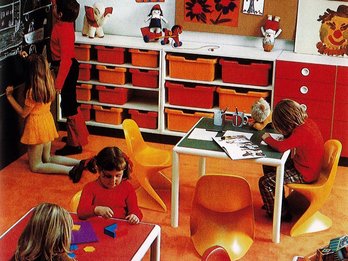
Designing Childhood © Design Museum Brussels
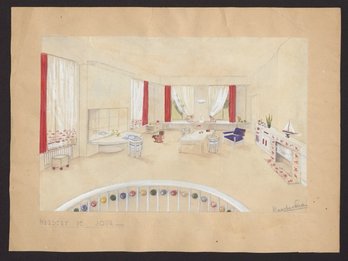
Sylvie Feron & René Baucher, Vue interieur nursery de jour © Design Museum Brussels
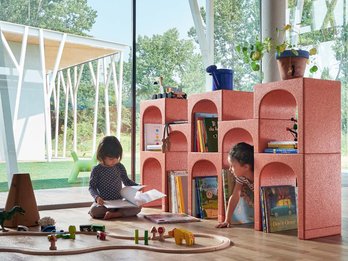
Giulio Iachetti – Eur © Magis
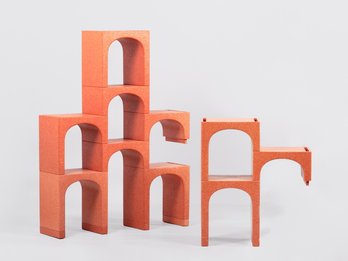
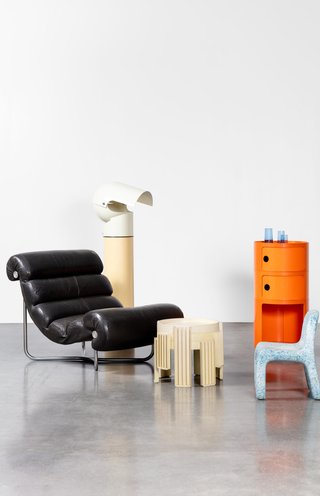
Giulio Iachetti – Eur, 2013 © Design Museum Brussels
A history of design for children
As a testing ground for new materials and production processes, children’s furniture has left its mark on the history of 20th-century design. It embodies the ambitions, social changes and technological advances of its era. Gradually recognised as individuals in their own right, children are no longer seen as ‘little adults’ and have carved out a specific place for themselves in the home, society and the market.
As explorers of the world, children learn, play and express themselves through the objects that populate their daily lives. After the Second World War, home design evolved: children’s bedrooms and playrooms appeared, offering young children spaces conducive to creativity and imagination. Furniture then became a tool for learning as much as a means of emancipation.
Designers found children’s furniture to be a privileged field for experimentation. In the 1960s, the rise of polymers paved the way for new forms, free from traditional constraints. These materials made it possible to invent lightweight, ergonomic and playful furniture without sharp angles. Many designers embraced this field: Jean Prouvé, Alvar and Aino Aalto, Hans Wegner, Charles and Ray Eames, Nanna Ditzel, Bruno Munari, Javier Mariscal and, more recently, Stéphanie Marin, each offering a vision of childhood as a field of experimentation and freedom.
Laboratory of the imagination
In this new collaboration, the Design Museum Brussels enriches the narrative initiated by the Centre Pompidou by highlighting the Belgian contribution. Through pieces from its collections, the museum emphasises the vitality of design in Belgium, in resonance with major international narratives. It reveals an approach that is attentive to children’s needs, integrating ecological and educational issues from an early stage. From children’s bedrooms designed by Sylvie Feron in the 1930s to Jules Wabbes, to the current initiatives of the ecoBirdy duo with the Charlie chair made from recycled plastic, Belgian designers also introduce childlike singularity into the domestic space. Thus, design in Belgium reflects a creativity where formal innovation is combined with a reflection on society and the environment.
Today, at a time of new environmental, social and technological challenges, children’s furniture continues to reflect its era. 3D printing, open source, recycled materials and local manufacturing herald a new generation of creative, responsible and accessible furniture.
This universe remains a formidable laboratory where imagination, learning and innovation come together, reminding us that design, at a child’s level, also illuminates our common future.
This temporary exhibition, in collaboration with Centre Pompidou, will be on display from 1 April to 20 September 2026.
Good to know
Sanitary facilities are available in the building.
The building is accessible to persons with limited mobility, provided that an adapted route is used. Please let us know in advance if your group includes participants with limited mobility.
The building does not have private parking. However, it is possible to park in the Brussels Expo car park, which is close to the museum.
The museum has a room where all the works on display can be touched and handled by visitors.
Reservation and guide fee. We are exempt from VAT.
You can buy admission tickets for the museum on site, so you can enjoy all the discounts the museum offers. More info about ticket prices: https://designmuseum.brussels/nl/bezoeken-in-groep/