Read along with Korei

Stories, insights, and walks that broaden your view of Brussels
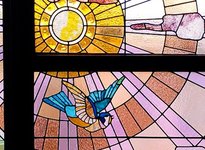
Detail glasraam huis Devalck © Korei Guided Tours

What is the difference between Art Nouveau and Art Deco?

Both Art Nouveau and Art Deco reflect crucial moments in European cultural history, forming a visual narrative about change, progress and identity when considered together. Art Nouveau is characterised by flowing lines, plant motifs and a strong artisanal style, where architecture, interior design and decoration are inextricably linked. Popular from the 1920s onwards, Art Deco opts for clean geometry, symmetry and luxurious materials, exuding modernity, progress and urban elegance.Brussels is an ideal place to learn about the differences between the two movements. Both movements have left their mark on the cityscape, but differ greatly in terms of atmosphere, form and ideology. If you look closely, you will not only see beautifully designed buildings, but also two different moments in Brussels' history.
read article →
David en Alice van Buuren © Archief Museum en tuinen van Buuren

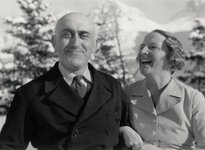
Who were David and Alice van Buuren?

The Van Buurens were among the most prominent figures in Brussels' cultural life during the interwar period. David and Alice's life story is closely intertwined with art, architecture, and landscape, forming the basis of what is now the Van Buuren Museum & Gardens.David Michel van Buuren (1886–1955) was originally from the Netherlands and was a successful banker who settled in Brussels in 1909. In 1922, he married Alice Piette (1890–1973), who was from Antwerp. The couple met at work, where Alice was an executive secretary. Together, they embarked on a lifelong project of collecting, supporting and exhibiting art. David van Buuren was not only a good friend of the painter Gustave Van de Woestyne, but also his patron.
read article →
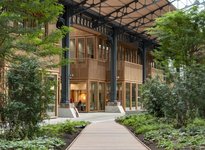
Binnenstraat Gare Maritime © Nextensa

The evolution of Tour & Taxis, from rural meadow to urban covered city

The Tour & Taxis site offers a rich historical narrative, showcasing a multifaceted evolution of trade, industrial heritage and urban development. The area, which was once open pastureland used for stagecoach horses, has grown into a crucial logistics hub for Europe. It is now evolving into a mixed-use urban district, combining residential, commercial, cultural and green spaces. Gare Maritime, the former freight station, in particular, serves as a nexus between the past and the future: a monumental structure that has been reimagined as a sustainable, covered city where architecture, reuse and public space converge.The Thurn und Taxis family established a European postal system for the Habsburgs in the 16th and 17th centuries, starting from Brussels. At that time, horses for the coaches grazed on the local meadows to the north of the city centre, just across the canal dug in 1550.
read article →
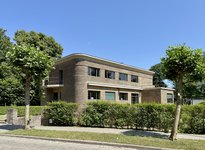
La Nouvelle Maison © Eva Lo

Modernism in Brussels? Absolutely!

Modernism emerged in the early 20th century against a backdrop of industrialisation, social reform, and technological innovation. Key figures such as Le Corbusier, Walter Gropius and Ludwig Mies van der Rohe rejected historical architectural styles, instead advocating functional and rational designs adapted to modern life.Cities such as Weimar, Dessau, Paris and Berlin became important centres of the movement. Iconic buildings such as the Bauhaus building in Dessau, the Villa Savoye near Paris, and the Barcelona Pavilion embodied modernist principles, including open floor plans, the use of new materials such as steel and reinforced concrete, and a pronounced absence of ornamentation.Modernism also took root in Belgium, particularly in the work of Henry van de Velde and, later, Victor Bourgeois. These architects played a key role in disseminating an international, progressive architectural language.
read article →
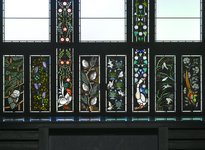
Glas-in-lood in gemeentehuis Vorst, Jean-Baptiste Dewin © Korei Guided Tours

The hidden animal kingdom in the town hall of Forest

Jean-Baptiste Dewin was a Brussels architect who developed a distinctive Art Deco style, centred on decoration, symbolism and local roots. Dewin (1872–1942) worked with clean lines and geometric structures in carefully chosen materials, which he enriched with figurative and naturalistic motifs wherever possible. The choice to depict local flora and fauna is a recurring theme in his oeuvre. In the homes and public buildings designed by the Brussels architect, we see cherries, acorns and owls incorporated into stained glass, mosaics and sculptures, among other things.The town hall of Forest (1924–1938) is a fine example of this approach. The building combines the clear layout and monumentality of Art Deco with a rich visual language that refers to the natural environment of Forest. The façades and interior feature stylised plants, trees, birds and animals, worked in relief stone and decorative panels. Even Little Red Riding Hood was given a place in the ensemble! The decorations lend the building a symbolic layer, linking the modern building to the history of the municipality, both recent and distant.
read article →