Palace of Justice: the largest courthouse in the world (ENG)


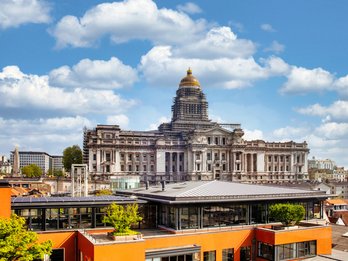
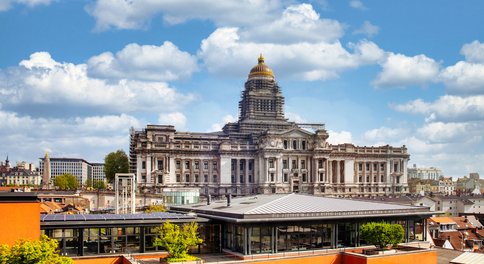
Paleis of Justice © Jean-Michel Byl visit.brussels
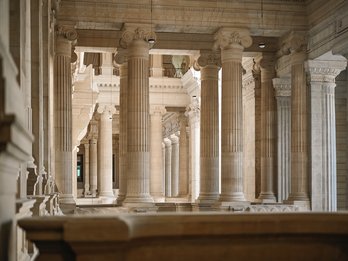
Colonnade surrounding the main entrance to the Palace of Justice © Korei Guided Tours
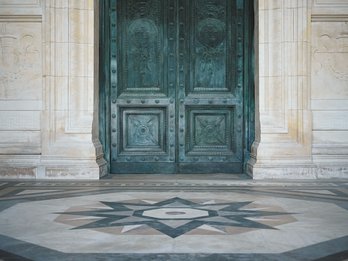
Bronze door at the main entrance to the Palace of Justice © Korei Guided Tours
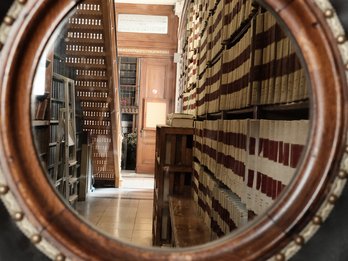
Palace of Justice © Marleen Van Antwerpen
Symbolism in an imposing monument under construction
In the 19th century, the Palace of Justice was the largest building ever to be constructed in Europe. More than 140 years later, its dome still dominates the Brussels skyline. Joseph Poelaert (1817–1879), the man behind it, was a stubborn jack-of-all-trades who rejected any fixed style. His boundless dedication drove him to exhaustion, and he never completed his monumental design. Poelaert viewed architecture as a moral and almost metaphysical task, believing that proportions, dimensions and motifs should make order, justice and the separation of powers visible.
And what about the never-ending renovations?
The removal of the scaffolding from the façade of the Palace of Justice made headlines in the national media in summer 2026. Quite rightly so, if you ask us. During a recent site visit, our guides were amazed by what they saw. They learned about the techniques used during the restoration and heard some fascinating anecdotes. For example, did you know that a fox lived on the construction site? The workers called him Luc.
A visit to the Palace of Justice isn’t limited to the façade, of course. We will take your group inside and guide you through the maze of staircases and endless hallways. As you go, you’ll learn about the symbolism in the ornamentation, how the justice system works and why the architect, Joseph Poelaert, was nicknamed the 'Skieve Architek'.
Practical
The corridor with the busts, the Assize Court, the Chamber of Solemn Sessions of the Court of Cassation, and the Chamber of Solemn Sessions of the Court of Appeal are closed to the public for restoration.
Please leave sharp objects such as nail clippers, nail files, forks, knives, scissors, pocket knives, etc. at home. When entering the Palace of Justice, you will pass through a security scanner. If sharp objects are found, you will be referred to the internal police for further investigation.
This procedure may be perceived as unpleasant or intimidating and takes extra time, which may cause you to miss part of the tour.
The Palace of Justice is a living and working building; therefore, attendance at a court hearing cannot be guaranteed. Despite these limitations, a visit to this impressive landmark remains well worth the experience.
The building has sanitary facilities.
The building is accessible to people with reduced mobility, provided that an adapted route is used. Please inform us in advance if you want to make use of this.
The price includes the ticket for the guided tour. You do not need to purchase admission tickets.
By purchasing this ticket, you agree to our general terms and conditions, and in particular the general terms and conditions for agenda activities (art. 11).
Calendar
View our calendar of walks and interior visits for individual participants